
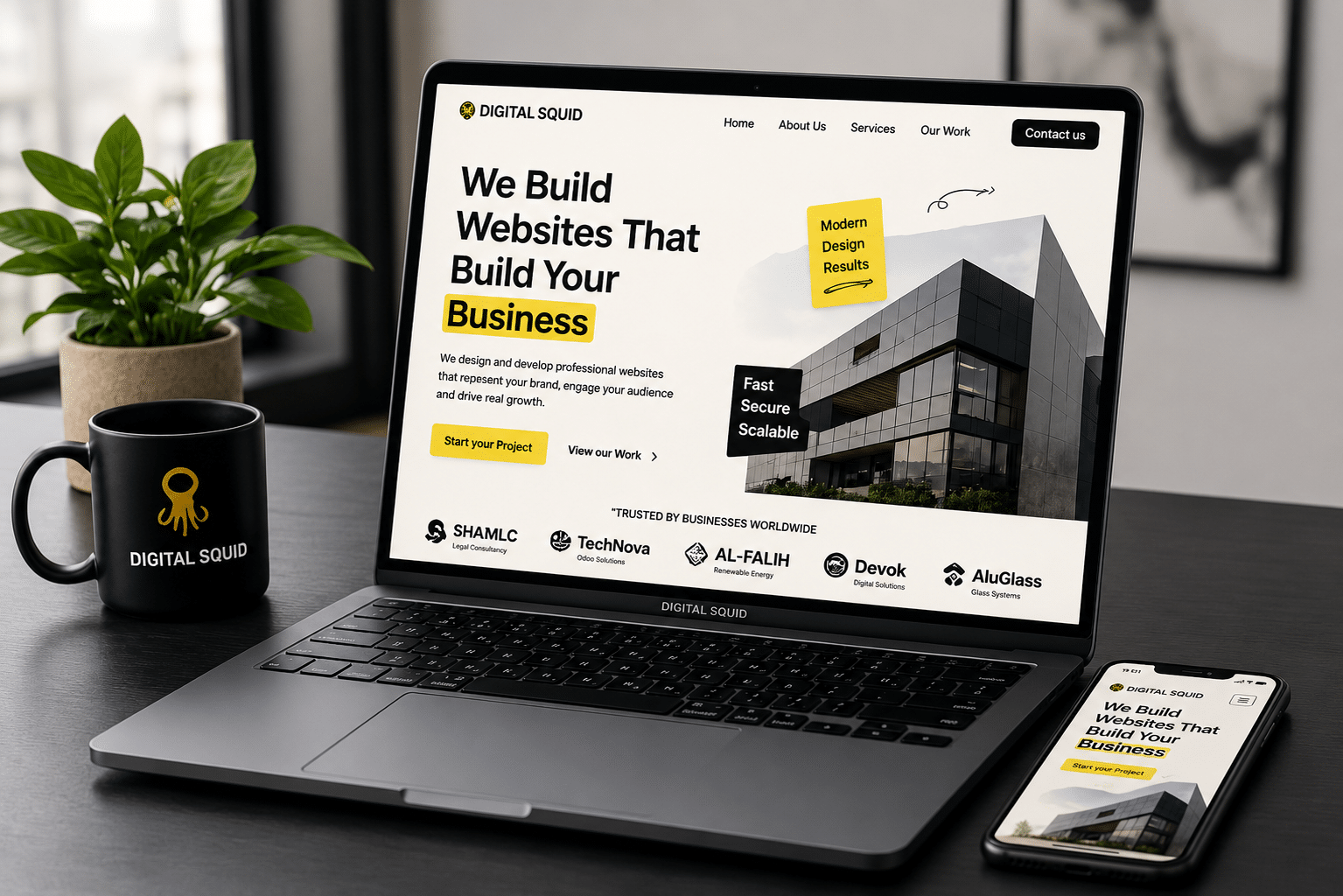
A professional website has become one of the most important digital assets for any business that wants to build trust, reach new customers, and create a stronger online presence.
You may already have active social media pages, publish content regularly, and receive good engagement. However, relying only on social media does not give your business full control over its digital presence.
A professional website acts as your official online headquarters. It gives customers one organized place where they can learn about your business, explore your services, review previous projects, and contact your team.
In this article, we explain why every business needs a professional website, how it differs from social media, and how it can help generate more opportunities.
What Is a Business Website?
A business website is an official digital platform that presents important information about a company, its services, and its value.
A typical business website may include:
- Home page.
- About page.
- Services pages.
- Portfolio or case studies.
- Blog.
- Frequently asked questions.
- Contact page.
A website is not only used to display information. It can also collect leads, receive quote requests, support bookings, present offers, and attract visitors through search engines.
1. A Website Builds Customer Trust
Before working with a new company, many customers search for it online.
They want to understand:
- What the company does.
- What services it provides.
- Whether it has previous experience.
- How they can contact it.
- Whether it appears reliable.
When customers find a professional website with clear information, organized services, previous work, and official contact details, they are more likely to trust the business.
If they only find an incomplete social media page, they may hesitate or choose a competitor with a stronger digital presence.
A professional website shows that your business is:
- Established.
- Organized.
- Accessible.
- Serious about its image.
- Clear about its services.
Trust begins before the first call. It often starts when the customer searches for your business online.
2. Your Website Is a Digital Asset You Control
Social media pages do not give businesses complete ownership or control.
Social platforms can change:
- Algorithms.
- Terms of use.
- Content reach.
- Advertising rules.
- Account features.
- Visibility settings.
An account may also become restricted, suspended, or inaccessible.
A business website gives you more control over:
- Content.
- Design.
- Customer data.
- Services.
- User experience.
- Contact methods.
- Search engine optimization.
Your domain and website become digital assets that can be developed over time without depending entirely on an external platform.
3. A Website Helps Customers Understand Your Services
One of the biggest challenges for many businesses is that customers do not fully understand what they offer.
On social media, information may be scattered across old posts, images, videos, and stories.
A website allows you to create a dedicated page for every important service.
Each service page can explain:
- What the service is.
- Who it is for.
- What problems it solves.
- What the customer receives.
- How the process works.
- Why customers should choose your company.
- How to request the service.
The better customers understand the service, the easier it becomes for them to contact you.
4. Your Website Works Around the Clock
A website is available at all times.
Customers can visit it during or outside business hours to explore:
- Your company.
- Your services.
- Previous projects.
- Frequently asked questions.
- Contact information.
- Available offers.
They can also submit a form, request a quotation, or send an inquiry at any time.
This allows your website to function as a digital sales representative that provides essential information before direct communication begins.
5. A Website Helps Your Business Appear on Google
A properly structured website can help your company appear in search results when customers search for services related to your business.
For example, an interior finishing company may target searches such as:
- Interior finishing company in Cairo.
- Apartment finishing cost.
- Best interior design company.
- Home finishing steps.
A website can create dedicated service pages and articles for these topics.
This gives your business more opportunities to appear in search results and attract potential customers.
Social media pages do not provide the same level of flexibility when targeting specific search terms and services.
6. It Attracts Customers with Real Interest
A visitor who reaches your website through Google is often searching for a specific service, answer, or solution.
This visitor may be closer to making a decision than someone who sees a random social media post.
A website can attract interested customers through:
- Service pages.
- Blog articles.
- Landing pages.
- Case studies.
- Local service pages.
- Quote request forms.
Each page can target a specific customer need and guide visitors toward the correct action.
7. It Presents Your Previous Work Professionally
Previous work is one of the strongest factors in a customer’s decision.
A website gives you the space to present projects in an organized and professional format.
Each project can include:
- Project name.
- Business category.
- The original challenge.
- The solution provided.
- Project images.
- Results.
- Customer feedback.
Instead of sending random images and links, you can direct potential customers to a portfolio or case study page that clearly demonstrates your experience.
8. It Helps You Collect Customer Information
A website can include forms that collect important information from potential customers.
For example:
- Name.
- Phone number.
- Email address.
- Required service.
- Estimated budget.
- Project details.
These forms can also be connected to:
- Email.
- Google Sheets.
- Customer management systems.
- Analytics tools.
- Messaging platforms.
This makes it easier for your sales team to organize inquiries, follow up with customers, and understand where each lead came from.
9. It Supports Advertising Campaigns
Sending advertising traffic directly to a social media profile or a general homepage is not always the best option.
A dedicated landing page can be created for each campaign.
A good landing page may include:
- A clear headline.
- Offer details.
- Service benefits.
- Previous projects.
- Customer reviews.
- Common objections.
- Contact form.
- WhatsApp button.
- Strong call to action.
When the landing page matches the advertisement, customers can understand the offer more easily and are more likely to take action.
10. It Allows You to Measure Results
When your website is connected to analytics tools, you can understand how visitors interact with it.
You can track:
- Number of visitors.
- Most visited pages.
- Traffic sources.
- Search keywords.
- Submitted forms.
- WhatsApp clicks.
- Phone clicks.
- Conversion rates.
- Devices used.
- Pages where visitors leave.
Useful tools include:
- Google Analytics.
- Google Search Console.
- Google Tag Manager.
- Microsoft Clarity.
This data helps you improve the website and marketing campaigns based on real user behavior rather than assumptions.
11. It Helps Your Business Stand Out
Many companies offer similar services.
The difference is not always the service itself. It is often how the service is presented.
A professional website helps you communicate:
- Your identity.
- Your experience.
- Your working process.
- Your strengths.
- Your previous projects.
- Your value.
- What makes you different.
These elements help customers understand why they should choose your company instead of a competitor.
12. It Strengthens Your Brand
A website is more than a group of pages containing text and images.
It is an important part of your brand identity.
Through your website, you can maintain consistency in:
- Colors.
- Fonts.
- Tone of voice.
- Service presentation.
- Marketing messages.
- Images.
- Customer experience.
When your website, social media, and advertisements follow the same identity, your brand becomes easier to recognize and remember.
Website or Social Media?
A website and social media do not replace each other.
They serve different purposes.
Social media helps you:
- Reach audiences.
- Publish content.
- Build engagement.
- Run advertising campaigns.
- Communicate quickly.
A website helps you:
- Present your business professionally.
- Organize your services.
- Appear in Google.
- Collect customer information.
- Present previous work.
- Measure visitor behavior.
- Control your content.
The best strategy is to use social media to attract attention and direct interested users to a professional website that helps them understand the business and make a decision.
What Pages Does a Business Website Need?
The required pages depend on the type of business, but most company websites should include the following.
Home Page
The home page provides a clear overview of the business, services, strengths, previous work, and contact methods.
About Us
This page explains the company story, experience, mission, vision, and values.
Services
A main services page can provide an overview, while each important service should have its own dedicated page.
Portfolio or Case Studies
This section presents previous projects and explains how the company helped its customers.
Blog
The blog contains useful articles that improve search visibility and build trust.
Frequently Asked Questions
This page answers common customer questions and objections.
Contact Us
The contact page should include a form, phone number, email address, location, and social media links.
What Makes a Website Professional?
Having a website does not automatically mean it will generate results.
A professional website should be:
- Fast.
- Mobile-friendly.
- Easy to use.
- Clearly organized.
- Search-engine friendly.
- Secure and protected by HTTPS.
- Consistent with the brand identity.
- Built around clear calls to action.
- Easy to update.
- Connected to analytics tools.
- Able to grow with the business.
Visual design is important, but it must work together with content, performance, and user experience.
Common Business Website Mistakes
No Clear Goal
A website may look attractive, but visitors may not understand what to do next.
Every important page should include a clear call to action, such as:
- Request a quote.
- Start your project.
- Book a consultation.
- Contact us.
- View our work.
Putting All Services on One Page
Each important service should have its own page with detailed information and targeted keywords.
Using Generic Content
Statements such as “We are the best” or “We provide the highest quality” are not enough without proof, examples, or clear explanations.
Ignoring Mobile Users
The mobile version should be reviewed carefully, not treated as a smaller copy of the desktop design.
Uploading Large Images
Unoptimized images can slow down the website and reduce engagement.
Not Tracking Conversions
Important actions such as form submissions, phone clicks, WhatsApp clicks, and button interactions should be measured.
Do Small Businesses Need a Website?
Yes.
A professional website is not only for large companies.
It can be especially valuable for small businesses because it helps them appear more professional and compete with larger brands.
A small business can begin with a simple website containing:
- Home page.
- About page.
- Services.
- Portfolio.
- Contact page.
More pages, articles, and features can be added as the business grows.
The website should be built in a way that supports future development.
How Much Does a Business Website Cost?
The cost depends on several factors, including:
- Number of pages.
- Number of languages.
- Design requirements.
- Content writing.
- Required features.
- Booking systems.
- Forms and integrations.
- SEO setup.
- Speed optimization.
- Hosting and domain.
- Ongoing support.
The lowest price is not always the best choice.
The more important questions are:
- What is included?
- Is the website easy to manage?
- Is it secure?
- Is it fast?
- Is it mobile-friendly?
- Can it grow with the business?
How to Start Building Your Business Website
The process can be divided into clear steps:
- Define the website goal.
- Identify the target audience.
- Organize the services.
- Plan the required pages.
- Prepare the content.
- Choose the domain and hosting.
- Design the user interface.
- Develop the website.
- Optimize mobile responsiveness.
- Improve loading speed.
- Configure essential SEO settings.
- Test forms and links.
- Connect analytics tools.
- Launch and monitor performance.
The clearer the planning stage, the smoother the development process becomes.
Frequently Asked Questions
Can I Use a Facebook Page Instead of a Website?
Facebook can help with communication and content publishing, but it does not provide the same level of control, professionalism, search visibility, and organization as a website.
Does a Website Guarantee More Customers?
No website can guarantee customers by itself. However, a professional website creates the foundation needed to build trust, attract traffic, support advertising, and convert visitors into inquiries.
Does My Business Website Need a Blog?
A blog is useful for businesses that want to target search keywords, answer customer questions, and build long-term authority.
Can the Website Be Expanded Later?
Yes. A properly developed website can be expanded with new pages, services, languages, articles, and features.
What Is the Difference Between a Website and a Landing Page?
A website presents the complete business, while a landing page focuses on one service, offer, campaign, or conversion goal.
Is WordPress Suitable for Business Websites?
Yes. WordPress is suitable for many business websites because it is flexible, scalable, and easy to manage after launch.
Conclusion
A professional website is no longer an optional addition for businesses.
It is an essential platform that helps you:
- Build trust.
- Present your services.
- Appear in Google.
- Attract interested customers.
- Display previous work.
- Support advertising campaigns.
- Collect leads.
- Measure performance.
- Strengthen your brand.
A clear, fast, and well-structured website gives your business a digital foundation that can continue growing over time.
At Digital Squid, we design and develop professional WordPress websites that are mobile-friendly, fast, scalable, and prepared with the essential SEO structure your business needs.
Ready to Build a Stronger Digital Presence?
Start Your Project
Explore Company Websites